

- August 24,2026
- BY Dr. Murray Fershtman
- 0 Comments
Fourth of July weekend just passed, and if your kid fell apart over something that seemed minor, a change in plans, too much noise, not getting the right seat, you might be sitting with a familiar question. Not “why did that happen” but “what is actually going on with my child?”
A lot of Texas parents come into the summer with this unresolved. The school year ends before anyone gets clear answers, and now there are eight weeks without the structure that usually holds things together. For some kids that’s fine. For others, the meltdowns get worse.
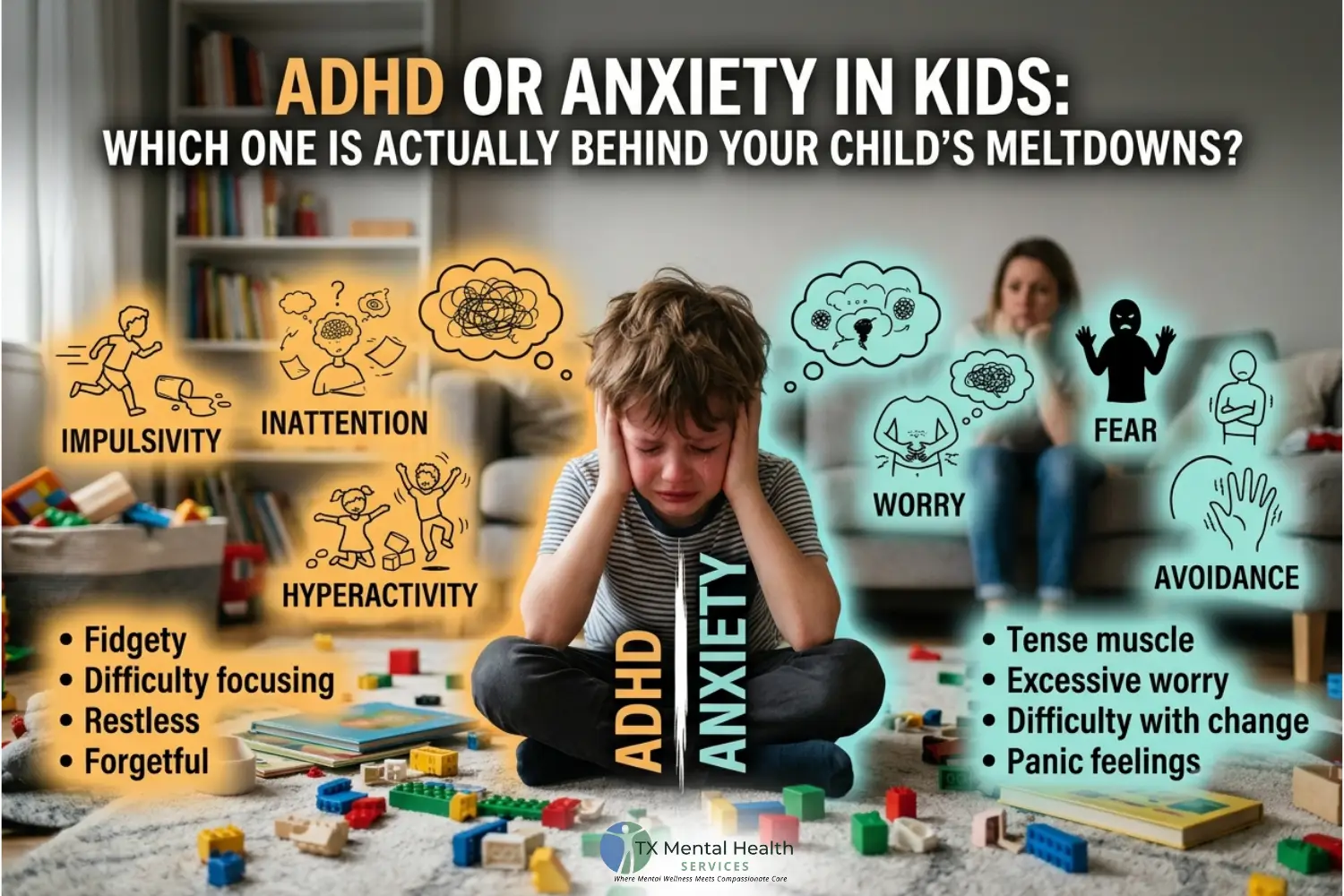
The question most parents are really asking even if they haven’t framed it this way yet, is whether what they’re seeing is ADHD vs anxiety in kids in Texas, or possibly both at once. This distinction matters enormously because the two conditions overlap in ways that genuinely fool parents, teachers, and sometimes even clinicians who don’t look closely enough.
Here’s a clear breakdown of what separates them, where they blur together, and why getting the right anxiety treatment matters more than most people realize.
Why This Gets Confused So Often
ADHD and anxiety produce similar-looking behavior on the surface. A child who can’t sit still might be hyperactive or might be so worried about something that they physically can’t settle. A child who zones out might have attention deficits or might be mentally consumed by a worry loop that looks identical from the outside.
This is the core of the overlap in ADHD and anxiety in children: the behavior is the same, but the reason behind it is completely different. And treating the wrong one or treating one while missing the other doesn’t work.
The Real Differences Between ADHD and Anxiety in Children
Let’s go through this directly, because the specifics are what actually help parents start to see the picture more clearly.
Inattention
| ADHD | Anxiety | |
| Why they zone out | Brain moves on to something more stimulating | Brain is stuck on a worry, fear, or “what if” |
| Does it happen with all tasks? | Yes — even enjoyable ones sometimes | Usually no — interesting tasks hold focus fine |
| What they’re thinking about | Not much — the mind just wandered | Something specific they’re worried about |
This is one of the most useful distinctions. A kid with ADHD loses focus because their brain is always looking for the next interesting thing. A kid with anxiety loses focus because their brain is occupied they’re not bored, they’re somewhere inside a worry that’s taking up all the space.
Hyperactivity and Restlessness
Both ADHD and anxiety produce restlessness and difficulty sitting still. But again, the source is different:
- ADHD restlessness — feels like surplus energy with nowhere to go, happens across situations
- Anxiety restlessness — feels more like agitation or tension, tends to spike in specific triggering situations
Meltdowns and Emotional Outbursts
This is where parents most often ask the question. Both ADHD kids and anxious kids melt down but what sets them off and what happens after tends to differ.
ADHD meltdowns often happen when:
- They’re asked to stop something they’re enjoying
- Transitions happen too fast
- They’ve been overstimulated and hit a wall
- Frustration builds from repeated failure at something
Anxiety meltdowns often happen when:
- They’re facing something uncertain or unfamiliar
- Plans change without warning
- They’re expected to do something that triggers their specific fear
- They’ve been holding it together all day and finally can’t
Behaviors That Look the Same But Mean Different Things
Behavior | ADHD Explanation | Anxiety Explanation |
Avoids homework | Can’t sustain focus, bored | Fears making mistakes or being judged |
Doesn’t follow instructions | Forgot, got distracted | Froze because the task felt overwhelming |
Cries when things change | Frustrated by transition | Genuinely scared of what’s different |
Can’t sleep | Brain won’t slow down | Worrying about tomorrow |
Physical complaints before school | Sometimes attention-related | Very often anxiety-driven |
Asks the same question repeatedly | May not, this is more anxiety | Seeking reassurance about something feared |
Does My Child Have ADHD or Anxiety: The Signs That Actually Help Narrow It Down
Here’s a practical way to think about it:
More likely ADHD if:
- The inattention and impulsivity show up across all settings, not just stressful ones
- Your child has always been this way, even as a toddler
- They lose things constantly, forget conversations, jump between activities
- They do better with structure, timers, and external reminders
- The behavior isn’t tied to specific fears or worries
Not sure if what you’re seeing is serious enough to act on? Read when to seek help for ADHD symptoms and when not to ignore them.
More likely anxiety if:
- The behavior clusters around specific situations, places, or types of tasks
- Your child worries out loud, asks “what if” questions, seeks constant reassurance
- Stomachaches and headaches show up regularly before school or events
- They seem to know what they’re supposed to do but freeze when it’s time to do it
- Sleep is frequently disrupted by worrying thoughts
More likely both if:
- You’re nodding at things in both lists
- Different settings trigger different presentations
- Treatment for one helped somewhat but didn’t resolve the full picture

Not Sure if It’s ADHD, Anxiety, or Both?
A comprehensive evaluation can help identify what’s really behind your child’s behaviors.
ADHD Misdiagnosis in Kids in Conroe TX : Why It Happens
This happens to families in Conroe, TX and families in other areas as well. A lot of ADHD diagnoses can happen in school-aged children compared to anxiety diagnoses, as ADHD is more likely to be recognized with the behaviors of hyperactivity and inattentiveness. Anxiety can present quietly and teachers would have to look closely to notice.
A child who freezes before a test gets labeled inattentive. A child who refuses to participate in group activities gets labeled oppositional. A child who’s constantly moving gets labeled hyperactive. Sometimes those labels are accurate. Sometimes they’re the anxiety that never got identified underneath. For a closer look at how depression, ADHD, and anxiety overlap, read I don’t feel like doing anything, is it depression, ADHD, or anxiety?
What Happens When Anxiety Gets Treated Like ADHD
This is where it gets clinically important. Stimulant medications for ADHD can actually make anxiety worse in some children, increasing the racing thoughts and physical tension that were already the underlying problem.
ADHD has a spectrum of similar symptoms to other disorders of which anxiety is a primary or co-occurring disorder. It is important to evaluate these conditions especially where treatment has resulted in a net negative or is not a clear improvement as evidenced by increased emotional reactivity and irritability and anxiety.
In evaluating the conditions stimulant medication is not always contraindicated. The assessment needs to determine the impact of all the conditions prior to making ADHD Treatment Conroe TX decisions.
How the Evaluation Works in Texas
A proper evaluation for ADHD vs anxiety in kids in Texas goes well beyond a checklist. For a full guide on what ADHD evaluation and treatment looks like for Texas kids, read what parents need to know about ADHD treatment for children and teens in Texas. Here’s what a thorough process actually includes:
- Clinical interview with parents — developmental history, when behaviors started, specific situations that trigger them
- Direct interview with the child — age-appropriate conversation about how they experience their own thoughts and feelings
- Behavioral rating scales — completed by both parents and teachers to get input across multiple settings
- Screening for co-occurring conditions — because ADHD and anxiety can exist together, not as an either/or
- Review of school records and any previous evaluations
- Diagnosis and treatment planning — including which condition to address first if both are present
The setting of evaluation matters too. A telehealth-capable provider serving Texas families can reach kids in Conroe, The Woodlands, and surrounding areas without the long wait times that in-person specialists often involve.
FAQs
Can a child have both ADHD and anxiety at the same time?
Yes, and it’s actually very common. Research consistently puts the co-occurrence rate at around 50 percent or higher meaning a significant portion of kids with ADHD also have an anxiety disorder. This is exactly why evaluating for both at the same time matters so much.
How is ADHD different from anxiety in children?
The most important distinction is the cause of the behavior. Inattention driven by ADHD happens due to the brain’s tendency to wander towards something that is more stimulating. Anxiety-driven inattention occurs because the brain is glued to a particular worry. Both look like you’re zoning out on the outside yet they are completely different areas.
Why do ADHD and anxiety get confused so often?
Because the outward behaviors of both seem to produce: restlessness, avoidance, emotional outbursts, difficulty concentrating, etc., without the cause of the behavior being clear. Behavior is clear to teachers and parents. They might not immediately see if it is caused by: impulsivity, fear, anxiety, or by a combination of these.
What's the key difference in how inattention shows up in ADHD vs anxiety?
Kids with ADHD tend to lose focus across the board, even on things they enjoy. Kids with anxiety tend to lose focus specifically when something triggers their worry they can often concentrate fine on low-stakes tasks they feel safe with.
My child's teacher says ADHD but I think it's anxiety, who is right?
Possibly both, possibly neither, possibly one more than the other. A teacher sees one setting. A parent sees another. A proper clinical evaluation pulls information from both sources and adds a direct clinical assessment. That’s what actually answers the question.
Does treating ADHD with stimulant medication make anxiety worse?
In some children, stimulants can actually heighten anxiety. Some of the symptoms of anxiety are an increased heart rate, racing thoughts, and physical tension. Stimulants will all worsen pre-existing anxiety symptoms. This is why it is critical to identify anxiety within the child before the start of medication. This is not necessarily because stimulants are harmful to children who have both conditions; it is more to say that the treatment plan should be formulated to consider both conditions.
How is the ADHD vs anxiety distinction made during an evaluation in Texas?
Using a combination of parent and teacher rating scales, direct clinical interview with child, developmental history, and school records. Evaluators look for patterns in more than one context and consider both conditions when they cannot rule one out based only in one context.
Get a Real Answer, Not Just a Label
If you’ve been going back and forth on this ADHD, anxiety, something else entirely TX Mental Health Services is set up to actually figure it out. Under Dr. Murray Fershtman, M.D., the practice provides evidence-based evaluation and treatment for ADHD vs anxiety in kids across Texas, ages 4 to 22, with telehealth available so you’re not stuck on a six-month waiting list.
📞 Contact TX Mental Health Services today at (346) 589-9977 or email us at txmentalhealthservices@gmail.com to schedule an evaluation and get clarity on what’s actually going on with your child.